


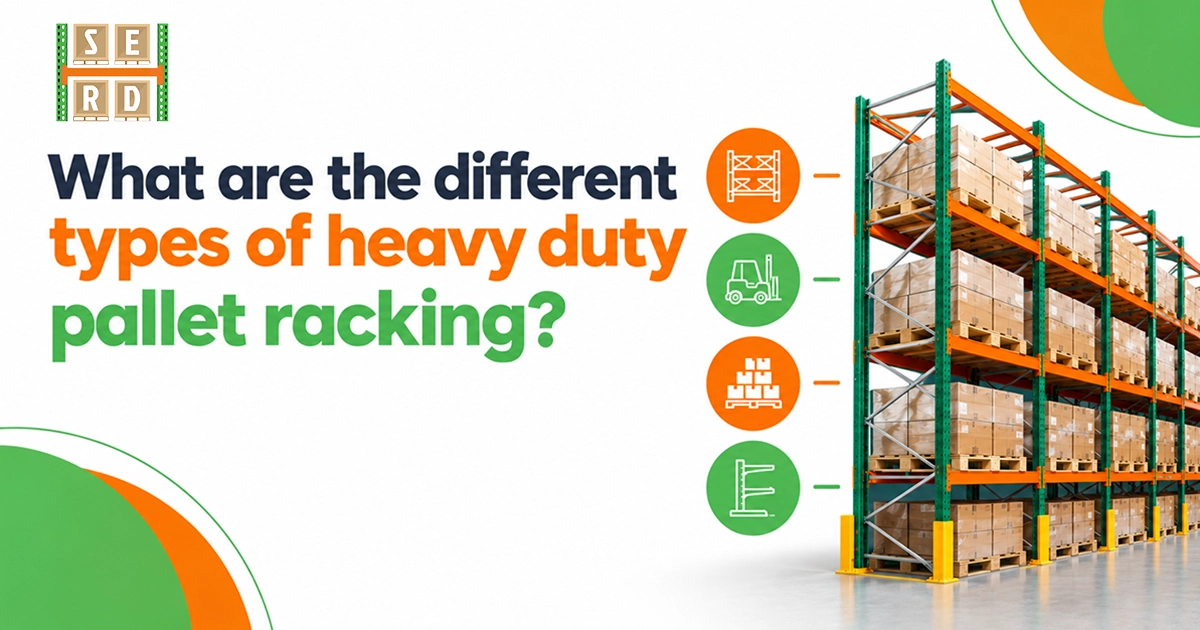
What are the different types of heavy duty pallet racking?
Heavy duty pallet racking comes in several main types, including selective, drive-in, drive-through, double-deep, push-back, pallet-flow, and cantilever systems. Each is designed to balance storage density, accessibility, and the types of products being stored. Choosing the right system depends on how frequently you access each pallet, your inventory requirements, available warehouse space, and the loads your racks must support.
Safety is equally important. Rack design, installation, loading, and maintenance must account for the system’s specifications and applicable building and workplace safety requirements. Understanding these factors helps warehouse operators make better storage decisions while reducing the risk of rack damage and collapse.
Key Takeaways
- Selective pallet racking provides direct access to individual pallet positions and works well for warehouses with many SKUs.
- Drive-in, push-back, and pallet-flow systems can increase storage density, although each has different inventory-access and rotation characteristics.
- Cantilever racking is designed for long, bulky, or irregularly shaped products that do not fit standard pallet positions.
- Rack load capacity must be respected. Use the applicable capacity information and manufacturer documentation when planning and loading a system.
- Safety requirements depend on the rack design and applicable codes. ANSI MH16.1-2023 covers specified industrial steel storage racks but excludes drive-in, drive-through, and cantilever racks.
- Routine inspections and prompt damage reporting help identify unsafe conditions before they lead to more serious problems.
Heavy duty pallet racking is not a single product. It is a category of storage systems designed for different warehouse operations. Selecting the wrong configuration can reduce picking efficiency, waste valuable floor space, and create operational or safety concerns.
This guide explains the main types of heavy duty pallet racking, their advantages, how to choose the right system, and the safety practices warehouse operators should understand.
Types of Heavy Duty Pallet Racking
1. Selective Pallet Rack
Selective pallet racking is one of the most widely used warehouse storage systems. It provides direct access to each pallet position from the aisle, allowing operators to retrieve products without moving other pallets first.
Two common connection styles are teardrop and keyhole-style, sometimes called Keystone, rack systems. Teardrop systems use shaped slots in the upright frames, while other systems use different connection designs. Beam and upright compatibility varies by manufacturer, so components should not be mixed without confirmation that they are compatible and approved for the intended configuration.
Best for: Warehouses with many SKUs, frequent picking, and inventory that requires direct access.
Main advantage: Straightforward access to individual pallets.
Main consideration: The aisles required for forklift access can reduce overall storage density compared with some high-density systems.
2. Drive-In and Drive-Through Rack
Drive-in and drive-through racking allow forklifts to enter storage lanes to place or retrieve pallets. Pallets are stored several positions deep, reducing the number of aisles needed between rack sections.
Drive-in systems are typically accessed from one end, while drive-through systems can be accessed from both ends. Drive-in configurations commonly operate on a last-in, first-out (LIFO) basis. Drive-through layouts may support different inventory flows depending on how loading and unloading are organized.
Because forklifts operate inside the storage structure, correct pallet placement, appropriate operating practices, and protection against rack impacts are especially important.
Best for: High-volume storage with relatively few SKUs per lane.
Main advantage: Greater storage density than many conventional selective layouts.
Main consideration: Access to individual pallets is more limited, and the system requires careful forklift operation and inventory planning.
3. Double-Deep Rack
Double-deep racking stores two pallets deep, reducing the number of aisles needed compared with a single-deep selective layout. Access to the rear pallet generally requires suitable reach equipment or another manufacturer-approved handling arrangement.
This system can provide a practical balance between storage density and pallet accessibility. However, operators should account for equipment requirements, product turnover, and the additional handling needed to reach rear positions.
Best for: Warehouses seeking more storage density than standard selective racking provides, particularly where multiple pallets of the same product are stored together.
Main advantage: Increased pallet capacity without using a full drive-in layout.
Main consideration: Rear pallets are not directly accessible from the aisle, and specialized handling equipment may be required.
4. Push-Back Rack
Push-back racking uses carts or comparable mechanisms on inclined rails. When an operator loads a pallet at the front, it pushes previously stored pallets farther back. When the front pallet is removed, the next pallet moves toward the loading and retrieval position.
This arrangement allows multiple pallets to be stored deep in a lane while keeping forklift operations at the front of the rack. It can improve space utilization, although the actual storage capacity and operating speed depend on the design and warehouse workflow.
Best for: Warehouses storing multiple pallets per SKU that want high-density storage with access from one side.
Main advantage: Multiple pallet positions per lane with loading and retrieval from the same aisle.
Main consideration: Cart and rail condition, pallet compatibility, and proper loading procedures are essential to reliable operation.
5. Pallet-Flow Rack
Pallet-flow racking uses inclined tracks or rollers that allow pallets to move by gravity from the loading end toward the retrieval end. When the front pallet is removed, the next pallet advances into position.
This design commonly supports first-in, first-out (FIFO) inventory rotation, making it useful for products with expiration dates or defined stock-rotation requirements. Flow systems must be designed for the pallets and loads they will handle, and the flow components require appropriate maintenance.
Best for: High-volume operations that need predictable FIFO rotation.
Main advantage: Efficient movement of pallets through dedicated storage lanes.
Main consideration: System cost, pallet quality, load compatibility, and maintenance requirements can be higher than those of simpler rack configurations.
6. Cantilever Rack
Cantilever racking uses vertical columns with projecting arms to support products without front-facing vertical obstructions. It is particularly useful for materials that are long, bulky, or irregularly shaped, such as lumber, pipes, steel bars, and certain furniture products.
Arm spacing, load distribution, column capacity, and the dimensions of stored materials must be considered when designing a cantilever system. The rack should be configured according to the manufacturer’s specifications and the applicable design requirements.
Best for: Warehouses, lumberyards, and industrial facilities storing long or awkwardly shaped materials.
Main advantage: Open-front access makes loading and unloading long products easier.
Main consideration: Arm capacity, load distribution, stability, and the dimensions of the materials must be evaluated carefully.
How to Choose the Right Pallet Racking System
The right heavy duty pallet racks should match your warehouse’s actual inventory and workflow. Consider these questions before selecting a system.
- How often must each pallet be accessed? Selective racks are suitable when individual pallet access is important. High-density options may work better when several pallets of the same product are stored together.
- Does your inventory require FIFO rotation? Pallet-flow systems are designed to support FIFO movement. Other systems may also support FIFO when the layout and operating procedures are planned appropriately.
- Are your products standard pallet loads or long materials? Conventional pallet racks suit compatible palletized goods, while cantilever racks are designed for long, bulky, or irregular products.
- How much floor space is available? Systems that reduce aisle requirements may increase storage density, but they can also introduce equipment, design, and operating costs. Compare total usable capacity rather than considering rack footprint alone.
- What are the dimensions and weights of your loads? Confirm pallet dimensions, maximum load weights, load distribution, beam elevations, and handling equipment before finalizing the design.
- What building and site conditions apply? Floor capacity, anchorage, seismic requirements where applicable, sprinkler clearances, and local building codes may affect rack design and installation.
A qualified rack designer or engineer can help evaluate these factors and determine a configuration appropriate for the warehouse.
Heavy Duty Pallet Racking Safety Rules
Safe warehouse storage requires more than choosing racks with a high advertised weight capacity. The rack structure, floor, anchors, stored loads, and handling equipment must work together within the system’s design limits.
Understand the Applicable Standards and Regulations
ANSI MH16.1-2023, Design, Testing, and Utilization of Industrial Steel Storage Racks, specifies requirements for certain industrial steel storage rack systems, including push-back and pallet-flow racks. Its stated scope excludes drive-in and drive-through racks, cantilever racks, portable racks, and racks made from materials other than steel.
Cantilever steel storage racks are addressed by a separate standard, ANSI MH16.3. The applicable requirements depend on the rack type, design, installation, and adopted building codes.
OSHA’s warehousing guidance identifies workplace hazards and relevant safety requirements. There is no single OSHA standard that covers every aspect of every pallet-racking system. Depending on the circumstances, applicable OSHA requirements may address issues such as material storage, safe equipment operation, and recognized workplace hazards.
Warehouse operators should therefore consult the applicable OSHA requirements, adopted building codes, rack documentation, and relevant standards rather than assuming one ANSI standard governs every rack configuration.
Display and Follow Rack Capacity Information
Rack capacity depends on the specific system design, component configuration, load arrangement, and installation conditions. Use the manufacturer’s documentation and applicable design information to determine permissible loads.
Where required by the applicable standard or code, provide the appropriate rack capacity information or load plaques in visible locations. Ensure that the information corresponds to the actual rack configuration.
Moving beams, changing frame layouts, adding components, or altering the way loads are supported can affect capacity. Do not assume that the original capacity information remains valid after an unapproved change. Have proposed modifications reviewed by the manufacturer or a qualified rack professional before putting the altered system into service.
Inspect Racks for Damage and Unsafe Conditions
A planned inspection program helps identify damage and other conditions that could compromise rack safety. Inspection procedures should reflect the rack manufacturer’s guidance, the facility’s operating conditions, and applicable requirements.
Check for conditions such as:
- Bent, cracked, or damaged uprights and beams.
- Missing or damaged beam connectors, locking devices, or other components.
- Loose or damaged anchors and base plates.
- Visible corrosion or deterioration.
- Frames that appear out of plumb or have shifted from their intended position.
- Damaged pallets, unstable loads, or loads that exceed permitted capacity.
- Signs of forklift impact or other structural damage.
Workers should report damage promptly, and responsible personnel should document and assess reported problems. If a rack appears unsafe, restrict access to the affected area and unload or repair it only under an appropriate, safe procedure. Significant damage or uncertainty about structural integrity should be assessed by a qualified professional before the rack returns to service.
Inspection frequency should be established according to applicable requirements, manufacturer recommendations, usage, and the likelihood of impact or damage. A one-time inspection at installation is not a substitute for ongoing monitoring.
Follow Manufacturer and Applicable Anchorage Requirements
Anchorage and base connections contribute to rack stability. Their design depends on the rack configuration, floor conditions, loading, and other site-specific factors.
Install anchors and connections as specified in the approved rack design and applicable codes. Do not assume that every rack uses the same anchor type or arrangement, and do not remove or alter anchors without an appropriate technical review.
The warehouse floor and concrete supporting the rack must also be suitable for the imposed loads. Where required, a qualified professional should evaluate the slab, anchors, and installation conditions before the system is placed into service.
Load Racks Correctly and Protect Against Impacts
Place pallets within the intended storage positions and follow the rack’s load limits and loading instructions. Loads should be stable, properly supported, and suitable for the beam spacing and rack configuration.
Forklift operators should use designated aisles, follow safe operating procedures, and avoid striking rack frames or beams. Where appropriate for the layout and risk assessment, use suitable column guards or other impact-protection measures.
Do not continue using damaged components simply because the rack still appears to be standing. Report the condition and have it evaluated before deciding whether the rack can safely remain in service.
Treat Rack Modifications as Engineering Changes
Changing beam levels, relocating frames, substituting components, or increasing the intended load can affect the structural performance of a rack system.
Before making changes, obtain confirmation from the rack manufacturer or a qualified rack designer or engineer that the revised configuration is suitable. Update capacity information and documentation when required.
Why Rack Selection and Safety Must Work Together
The correct rack system can improve warehouse efficiency while supporting safer operations. However, a layout that does not match the inventory, forklift equipment, or workflow can increase unnecessary handling and the likelihood of impacts or loading errors.
Selective racks may be suitable for frequently accessed products, while push-back or pallet-flow systems can support higher-density storage for appropriate inventory. Cantilever systems address the different requirements of long materials.
The goal is to choose a system that fits the warehouse’s products and operating needs, then install, load, inspect, and maintain it according to its design and applicable requirements.
At Southeast Rack Depot, we offer heavy duty pallet racks, including teardrop, Keystone-style, and heavy duty cantilever racking systems. Our warehouse design consultation team can help you evaluate storage options for your inventory and workflow. You can also read our guide to pallet racking types, load capacity, and dimensions.
Frequently Asked Questions
What is the most common type of heavy duty pallet racking?
Selective pallet racking is widely used because it provides direct access to individual pallet positions. It is particularly useful for warehouses with many SKUs and frequent picking requirements.
What is the difference between drive-in and drive-through racking?
Drive-in racking is generally accessed from one end, while drive-through racking can be accessed from both ends. Both store pallets several positions deep, improving storage density while limiting direct access to individual pallets.
Is cantilever racking considered heavy duty?
Yes. Cantilever racking is designed for long, bulky, or irregularly shaped materials such as lumber, pipes, and steel bars. The appropriate capacity depends on the specific rack design, arm configuration, and load distribution.
Does OSHA require a specific pallet-rack safety standard?
OSHA requirements apply to relevant workplace hazards and activities, but there is no single OSHA standard covering every type of pallet-racking system. ANSI standards and adopted building codes may also apply, depending on the system and jurisdiction. Consult the applicable requirements rather than treating one standard as universally controlling.
How often should heavy duty pallet racking be inspected?
Inspection frequency should follow applicable requirements, manufacturer recommendations, and the facility’s risk and operating conditions. Inspections should identify damage, displaced components, anchorage problems, unsafe loads, and other conditions that could affect stability. Workers should report damage immediately rather than waiting for a scheduled inspection.
Can different types of heavy duty racking be used in one warehouse?
Yes. A warehouse can combine selective racks for frequently picked products with higher-density systems for suitable bulk inventory and cantilever racks for long materials. Each system should be designed and installed for its intended loads, equipment, and operating conditions.
Final Thoughts
There is no single best type of heavy duty pallet racking for every warehouse. Selective racks prioritize direct access, drive-in and drive-through systems provide dense storage, push-back and pallet-flow systems support different high-density workflows, and cantilever racks accommodate long or irregular materials.
The best choice depends on inventory characteristics, access requirements, available space, handling equipment, and total operating costs. Equally important are appropriate design, correct loading, suitable anchorage, routine inspections, and prompt action when damage is discovered.
If you are unsure which system fits your operation, the Southeast Rack Depot team can help you evaluate your warehouse layout and storage requirements. Call (770) 630-2309 or request a quote.
Additional safety resources
- ANSI Webstore: ANSI MH16.1-2023
- OSHA: Warehousing standards and safety guidance
- Rack Manufacturers Institute (RMI)