


What Are Heavy Duty Pallet Racks?
If your warehouse floor is running out of room but your ceiling still has 15 feet of empty air above it, you already own the solution , you just haven’t built up into it yet. That’s the entire idea behind heavy duty pallet racking: steel storage structures engineered to stack loaded pallets several levels high, so a facility can multiply its storage capacity without adding a single square foot of floor space.
This guide breaks down exactly what heavy duty pallet racks are, how much weight they actually hold, the main types on the market, and how to pick the right one , with the real engineering detail most articles skip.
Looking to buy, sell, or install racking rather than just research it? Southeast Rack Depot supplies new and used heavy duty pallet racks across Atlanta and the greater Southeast, along with warehouse design, installation, and relocation services.
What Is a Heavy Duty Pallet Rack?
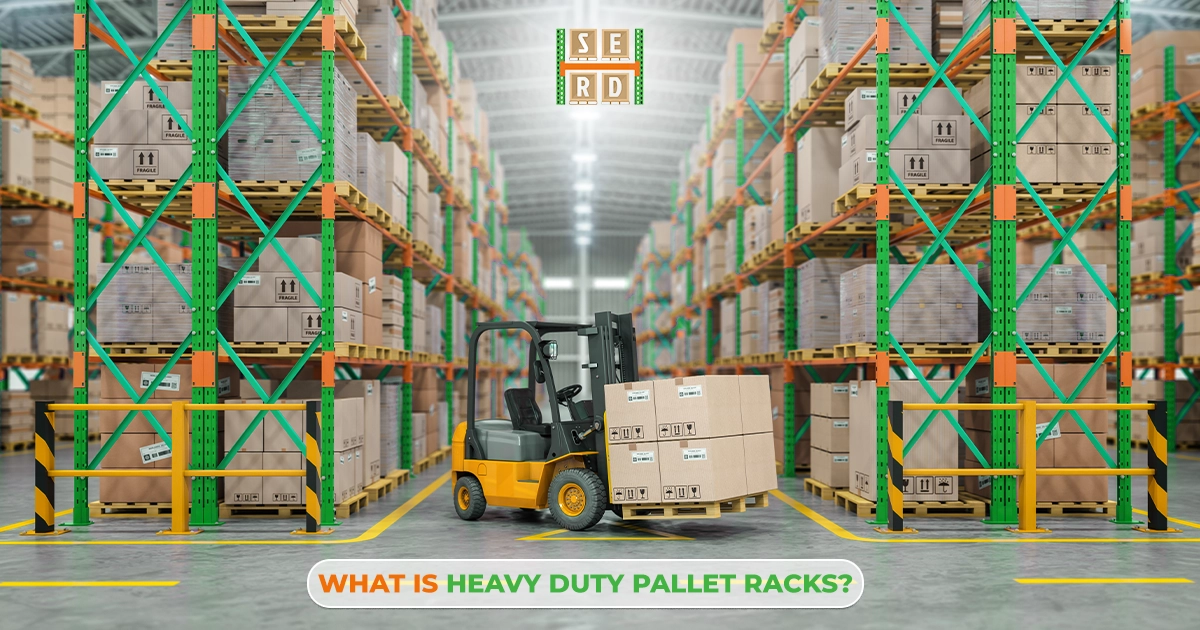
A heavy duty pallet rack is a steel storage system made of vertical upright frames and horizontal load beams that connect to form multiple shelf levels, each rated to hold one or more loaded pallets. Unlike light-duty shelving, heavy duty racks use thicker-gauge steel, deeper beam profiles, and reinforced upright frames so they can carry industrial loads , often several thousand pounds per level, without bending, sagging, or failing under repeated forklift traffic.
At its core, a rack system has three structural components:
- Upright frames – the vertical steel columns (with horizontal and diagonal bracing) that carry the load down to the floor
- Load beams – the horizontal bars that bolt or clip into the frames to create each storage level
- Decking – wire mesh, steel panels, or wood laid across the beams to support pallets or loose cartons
Because these three parts bolt or lock together, a heavy duty rack system can be reconfigured, expanded, or relocated as inventory needs change , something a fixed shelving unit or floor-stacked pallet stack simply can’t do.
Benefits Of Heavy Duty Pallet Racks
The advantages of heavy duty pallet racks go well beyond “more storage.” Here’s what a properly designed system actually delivers:
Maximizes Vertical Space
Floor space is the most expensive real estate in any warehouse. Heavy duty racking lets you build upward , often 20 to 40 feet , turning unused overhead air into usable storage without leasing or building additional square footage.
Higher Load Capacity Than Standard Shelving
Heavy duty beams (5″ to 6″ face profiles) commonly support 7,000 to 12,000+ lbs per pair, compared to 2,000–4,000 lbs for light-duty shelving. That difference matters when you’re storing palletized raw materials, machinery, or bulk goods.
Improves Warehouse Safety
Racks engineered to code , with proper anchoring, load plaques, column protectors, and wire back panels , reduce the risk of collapses, falling loads, and forklift collisions. Unlike stacked pallets on the floor, racking keeps loads contained, labeled, and structurally supported.
Boosts Picking and Order Fulfillment Speed
Organized, labeled rack bays mean workers and forklift operators spend less time searching for SKUs. Selective racking in particular gives 100% direct access to every pallet, cutting retrieval time significantly.
Scalable and Reconfigurable
Because components bolt together rather than being welded permanently, a rack system can be resized, moved, or expanded as your inventory grows , without tearing out and replacing the entire structure.
Long-Term Cost Efficiency
Expanding storage capacity through vertical racking is dramatically cheaper than leasing new warehouse space or constructing an addition. Most systems also carry 10+ year lifespans when properly maintained.
Better Inventory Protection
Elevated, structured storage keeps goods off the floor and away from moisture, dust, and accidental damage , particularly valuable for food, pharmaceutical, and electronics storage.
Types Of Heavy Duty Pallet Racks
Not every warehouse needs the same industrial racking systems. The right type depends on your SKU count, turnover speed, and how much you prioritize direct access versus storage density.
| Rack Type | Best For | Key Advantage |
|---|---|---|
| Selective Pallet Racking | High SKU counts, frequent picking | 100% direct access to every pallet |
| Drive-In / Drive-Thru Racking | High-volume, low-SKU storage | Maximum density; forklifts drive directly into lanes |
| Push-Back Racking | LIFO storage, 2–6 pallets deep | Loads and unloads from the same aisle |
| Pallet Flow (Gravity) Racking | FIFO, high-turnover goods | Gravity-fed lanes for fast, automatic replenishment |
| Double-Deep Racking | Warehouses needing extra density | Doubles storage without new floor space |
| Structural Steel Racking | Seismic zones, heavy industrial loads | Bolted steel connections outperform roll-formed racks |
| Cantilever Racking | Long, bulky, or irregular items | Arm-based design with no front columns blocking access |
| Mobile Pallet Racking | Cold storage, space-constrained warehouses | Movable carriages eliminate fixed aisles for maximum storage density |
Selective pallet racking remains the most widely used system because of its simplicity, low cost, and full SKU accessibility. Drive-in and push-back systems trade some selectivity for significantly higher density , ideal when you’re storing large quantities of a smaller number of products.
How Much Weight Can Heavy Duty Pallet Racks Hold?
This is the single most important safety question in warehouse racking, and it doesn’t have one universal answer. Capacity depends on three separate ratings that all apply simultaneously:
- Beam capacity – the maximum weight a pair of beams can hold on one level (heavy duty beams typically range from 7,000 to 12,000+ lbs per pair)
- Upright frame capacity – the total weight the vertical frame can carry across all levels combined, based on height, steel gauge, and beam spacing
- Bay capacity – the overall load limit of the entire rack section
The rule that trips up most warehouse managers: your rack’s true safe capacity is always the lowest of these three numbers , not the sum of them. A beam rated for 8,000 lbs doesn’t matter if the upright frame it’s bolted to is only rated for 20,000 lbs total across four levels.
Practical formula: Required beam capacity = heaviest pallet weight × number of pallet positions per level
Add a 20–25% safety margin on top of your calculated load to account for uneven weight distribution and forklift impact , and always confirm final numbers against the manufacturer’s load plaque or a rack engineer, since span length, steel gauge, and seismic zone all shift the real-world rating.
Common Uses Of Heavy Duty Pallet Racks
Heavy duty racking shows up anywhere large volumes of palletized goods need organized, elevated storage:
- Distribution centers and 3PL warehouses – high-turnover, multi-SKU storage
- Manufacturing plants – raw material and finished goods staging
- Cold storage and food distribution – FIFO-driven pallet flow systems
- Retail backrooms and big-box stores – bulk overstock above sales floors
- Pharmaceutical and chemical storage – controlled, code-compliant bulk storage
- E-commerce fulfillment centers – dense storage paired with fast picking
Choosing The Right Heavy Pallet Rack System
Before comparing vendors, get clear on four factors:
- Load requirements – your heaviest pallet weight, not your average
- SKU count and turnover rate – more SKUs favor selective racking; fewer SKUs at high volume favor drive-in or push-back
- Available height – taller ceilings justify denser, taller rack configurations
- Access needs – how often do you need to reach a specific pallet versus just moving bulk volume?
Getting this right the first time avoids the two most expensive racking mistakes: undersizing (which forces a costly retrofit later) and oversizing (which wastes vertical storage space you’re paying for either way).
If you’d rather not run these calculations solo, Southeast Rack Depot offers warehouse design consultations to match your load, SKU count, and ceiling height to the right rack configuration before you buy.
Heavy duty pallet racks turn wasted overhead space into your warehouse’s most valuable asset. Whether you need the full accessibility of selective racking or the raw density of drive-in and push-back systems, matching the rack type to your actual load and SKU profile is what separates an efficient warehouse from a costly bottleneck.
Ready to get started? Southeast Rack Depot sells new and used heavy duty pallet racking throughout Atlanta, Dalton, and the Southeast , plus design, shipping, installation, and relocation services to get your racking up and running correctly the first time. Get a quick quote or call (770) 630-2309.